

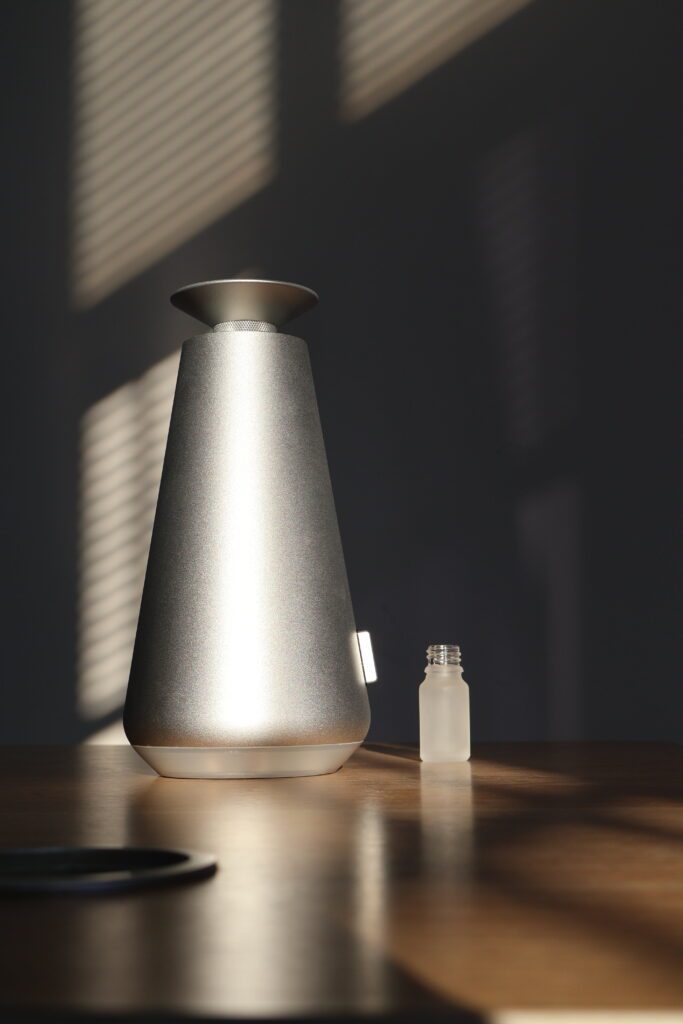
The equipment discussed here is a waterless cold-air fragrance diffuser. It uses airflow to atomize a compatible fragrance oil without adding water or deliberately heating the oil. This is a physical process that creates small liquid droplets—not a chemical reaction or a process that splits molecules.
From the reservoir to the room
Oil is supplied from a reservoir to an atomizing assembly. Airflow at the atomizer breaks the liquid into small droplets, which are carried into the surrounding air. Room air movement then affects where the scent is perceived. The exact feed arrangement, air pressure, nozzle and operating cycle depend on the device; check its manual rather than assuming every unit works identically.
Cold-air diffusion is not ultrasonic misting
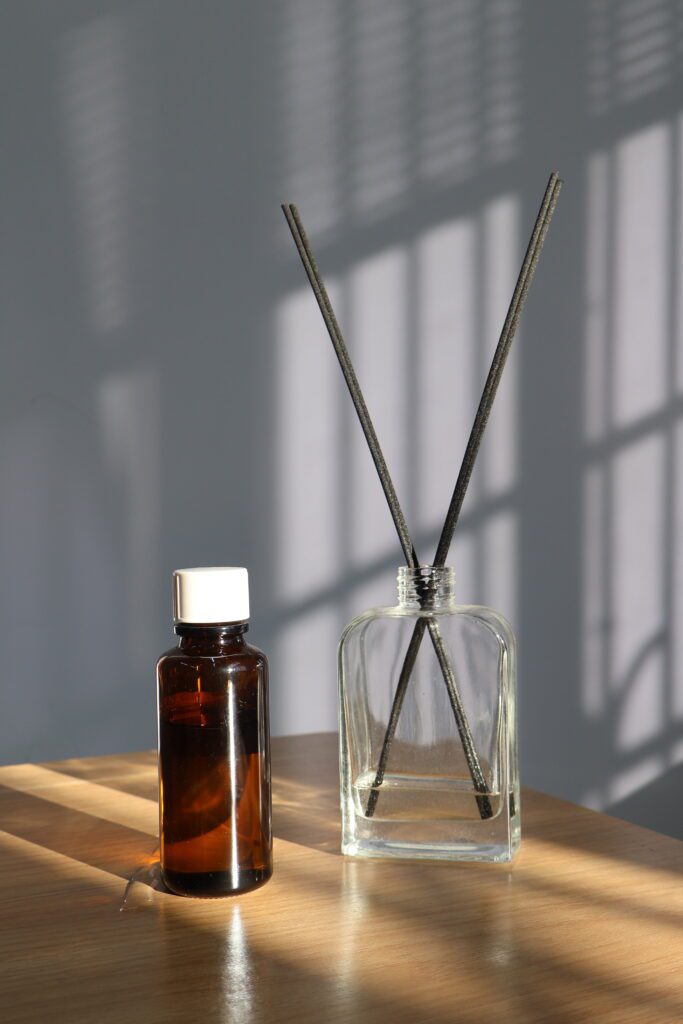
A typical water-based ultrasonic diffuser uses a vibrating element to produce mist from a water reservoir. A heated diffuser encourages evaporation by warming its contents. A reed diffuser relies on liquid movement through reeds and evaporation. The cold-air device described here instead atomizes oil using airflow, without a water reservoir or an oil-heating stage. These formats require different fragrance formulations and testing; suitability for one does not establish suitability for another.
Use an oil approved for the actual device
Neither “fragrance oil” nor “essential oil” on a label guarantees compatibility. Ask the equipment supplier about acceptable viscosity, composition, operating conditions and cleaning instructions. Do not add water, alcohol or other diluents unless the manufacturer specifically allows it. Test the selected oil for reliable delivery, scent, leakage, deposits and material compatibility in the actual unit before a bulk purchase.
Set output for the space, not just its floor area
Room volume, ventilation, open doors, airflow, placement and operating schedule all affect scent distribution. Start with the device supplier’s recommended settings and evaluate in the intended space. Record the operating cycle, oil consumption, perceived intensity at several locations and any deposits. Do not infer a universal coverage area or droplet size from the term “cold-air.”
Operation, documentation and project checks
Follow the equipment manual and the selected oil’s SDS for handling and maintenance. Keep outlets unobstructed, avoid directing mist at people or surfaces, and account for sensitive occupants. Waterless or unheated operation does not by itself prove a system is harmless, residue-free, an air purifier or a therapeutic product. Request the fragrance specification, SDS, batch COA, relevant IFRA information and allergen data; review the complete use scenario and destination-market requirements.

Frequently asked questions
Does it need water or a heater?
Not the cold-air system described here. It atomizes compatible oil using airflow. Other diffuser designs may use water or heat.
Does it change the oil into a new chemical substance?
The intended operation disperses liquid droplets. It is not a sulfur-based reaction, and “diatomic” is not the correct name for this diffusion mechanism.
Can SHEAIN select an oil for my project?
Share the device model or manual, space and ventilation, operating schedule, scent brief, target market and expected quantity. SHEAIN can review fragrance samples for evaluation; device compatibility and performance must be confirmed by testing.
Explore diffuser fragrance oils · Discuss a diffuser fragrance project


