

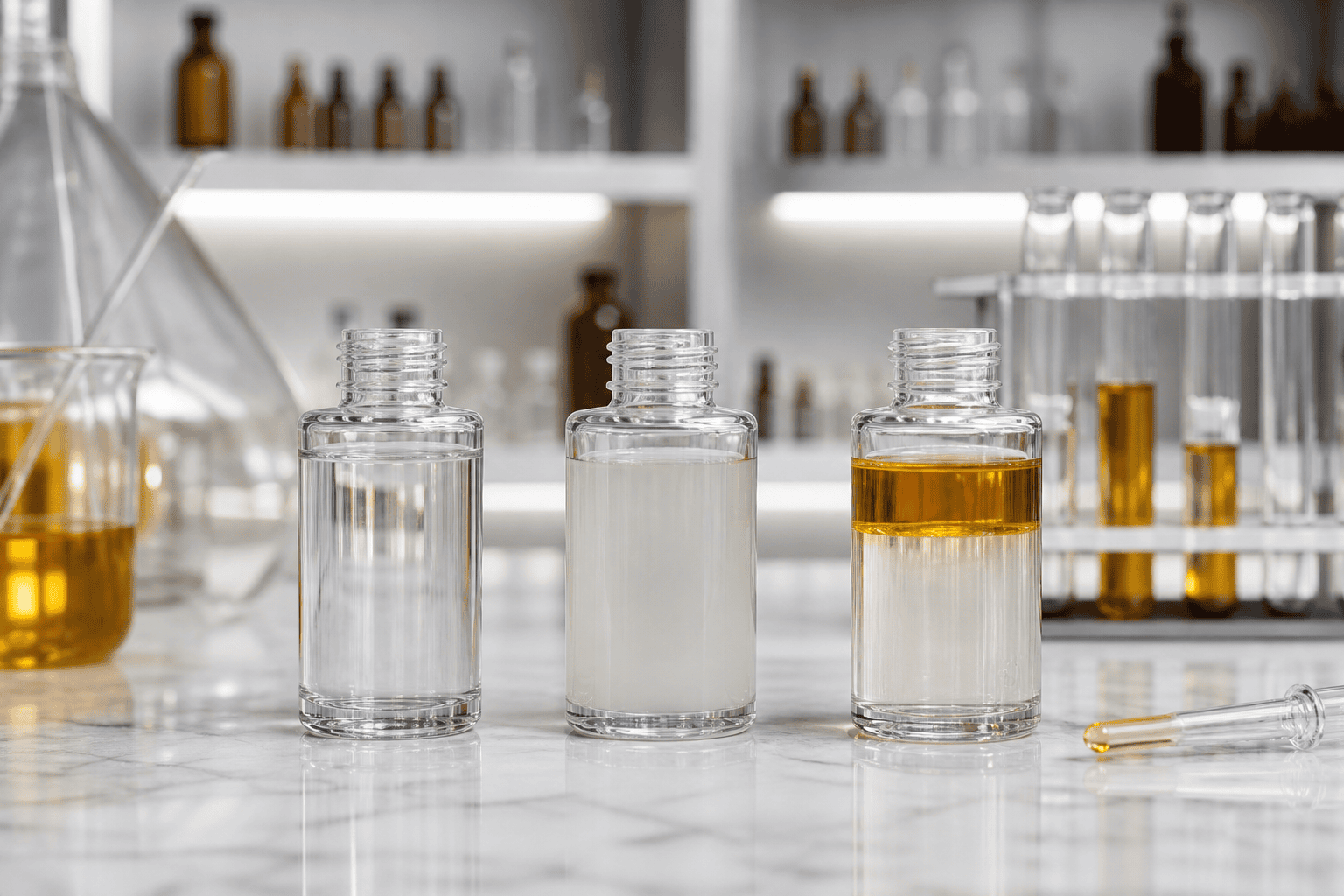
Fragrance oil solubility describes whether a fragrance can remain evenly dispersed or dissolved in a specific product base at the intended dosage. Cloudiness, separation and sediment are not solved by judging the neat oil alone: the complete formula, mixing process, temperature, water quality and storage conditions must be tested together.

What Controls Fragrance Oil Solubility?
Fragrance oils contain materials with different polarity and molecular weight. A water-rich base, alcohol system, surfactant concentrate or oil-based product therefore handles the same fragrance differently. Solubility can also change when salt, preservative, dye, active ingredient or pH adjuster is added.
| Observation | Possible cause | Next check |
|---|---|---|
| Immediate cloudiness | Insufficient solubilization | Dosage, surfactant and mixing order |
| Delayed separation | Marginal compatibility | Temperature cycling and aging |
| Sediment | Precipitation or contamination | Raw materials, filtration and water |
| Clear but weak odor | Fragrance trapped in the base | Application and headspace evaluation |
A Practical Compatibility Screening Process
- Prepare an unfragranced control and several fragrance dosages.
- Use the real manufacturing order, shear and temperature.
- Record initial clarity, color, odor, viscosity and pH.
- Store samples at controlled low, room and elevated temperatures.
- Run temperature cycles where appropriate.
- Inspect after defined intervals and after returning samples to room temperature.
- Confirm odor performance in the intended use condition.

Solubilizer Selection Is Formula-Specific
A higher solubilizer level does not automatically create a better product. It can affect foam, viscosity, skin feel, clarity, cost and fragrance release. Screen candidate systems against the complete base and consult the raw-material supplier’s use guidance. Any formula change should be included in stability and compatibility testing.
Manufacturing Variables Buyers Often Miss
Adding fragrance too quickly, using the wrong premix, changing batch temperature or substituting a surfactant can move a formula outside its compatibility window. Scale-up may introduce different shear and addition times. Document the approved process as carefully as the ingredient list.
How SHEAIN Supports Solubility Troubleshooting
SHEAIN can review the target base, dosage and product requirements, then provide fragrance samples for controlled comparison. Final compatibility must be validated by the finished-product manufacturer. Send us your base type, process and observed defect for a focused discussion.
Frequently Asked Questions
Is a clear sample always stable?
No. A marginal system can separate after heat, cold, dilution or extended storage.
Can water be added to fragrance oil?
Not reliably without a suitable system. The result depends on the oil and complete formulation.
Does more surfactant always improve clarity?
No. The surfactant type and ratio matter, and excessive use can harm other product properties.
Why does the lab sample differ from production?
Mixing energy, addition order, temperature, water and scale can all change dispersion.
Should clarity and fragrance strength be evaluated separately?
Yes. A clear formula may release fragrance differently from the preferred reference.


