

The choice between oil-soluble and water-soluble fragrance oil depends on the complete product system, not the word water or oil on the label. Many fragrances are oil-based mixtures that require solubilization in water, while commercial water-dispersible versions contain carriers that change performance. This guide helps product developers ask the right questions.
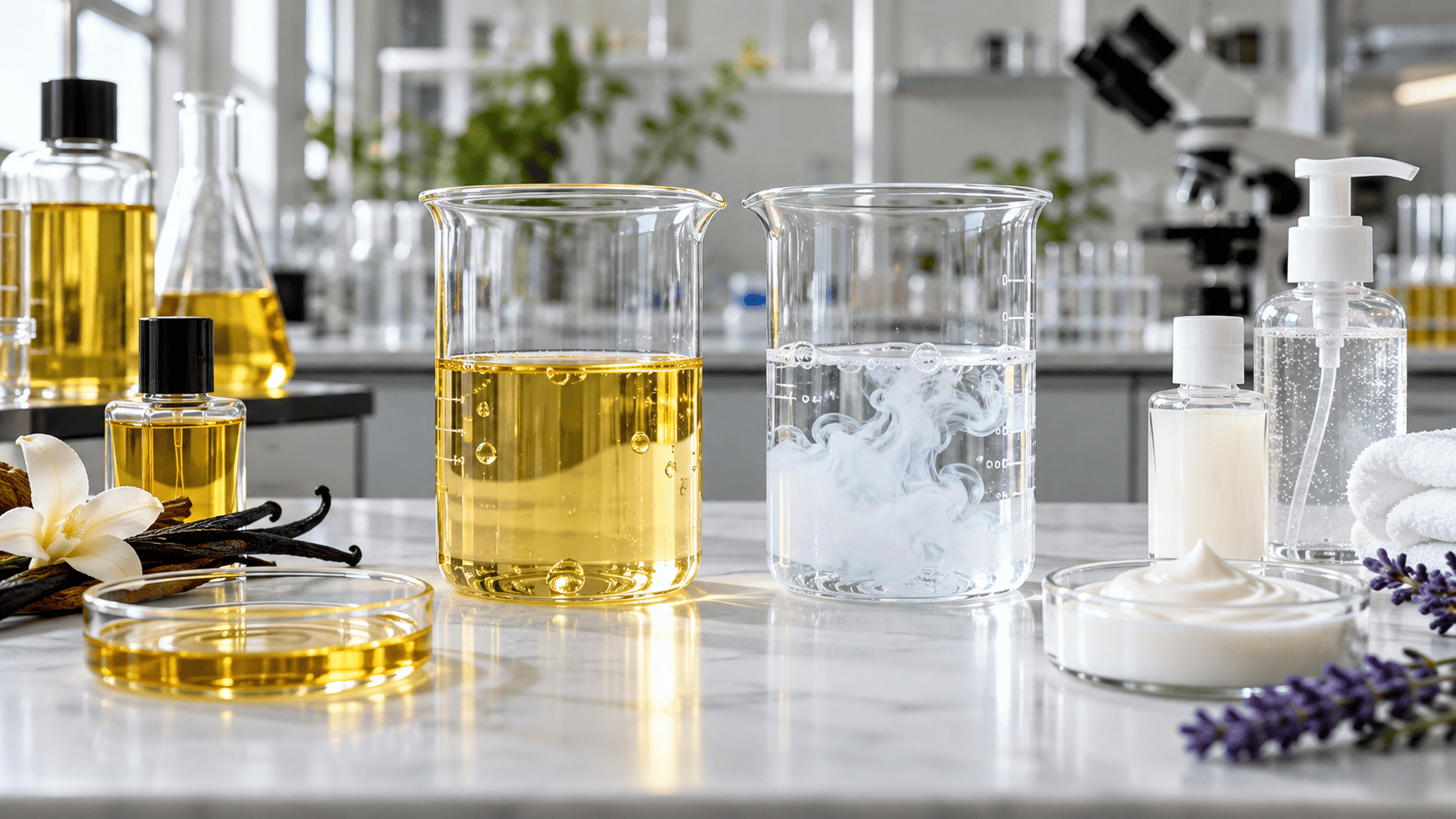
The objective is to make decisions from finished-product evidence, not fragrance-bottle impressions alone.
What Oil-Soluble Fragrance Means
Oil-soluble fragrance is designed to integrate into compatible oils, waxes, solvents or emulsions. It does not necessarily dissolve in every oil or remain stable in every cosmetic base. Candles, oil perfumes and some diffuser systems commonly use this form, but each application still needs compatibility testing.
What Water-Soluble Usually Means
The term often describes a fragrance supplied with solubilizing or dispersing components so it can enter a water-rich formula more easily. It may still create haze, foam, odor changes or preservative challenges. Ask the supplier for the exact intended applications rather than relying only on the label.
Match Fragrance Form to the Application
Candles and wax melts usually need oil-compatible fragrance. Clear water sprays may require a specially solubilized system or a separate solubilizer. Lotions and washes are emulsions or surfactant systems, so their behavior cannot be predicted simply from water content. Test the finished formula.

Compare Clarity and Sensory Performance
Prepare a control and dosage ladder using the intended manufacturing sequence. Check clarity, separation, sediment, viscosity, foam and odor. A water-dispersible option may improve appearance but change scent strength or cost. Select the best overall product, not only the clearest beaker.
Consider Preservatives and Stability
Adding carriers or solubilizers can change the environment of a water-based product. Review pH, preservation strategy and stability with qualified formulators. Run cold, room, warm and cycling studies appropriate to distribution, then test the final package.
Ask the Supplier Better Questions
Describe the base, pH, surfactants or emulsifiers, process, dosage, appearance target, packaging and market. Ask whether the sample is soluble, dispersible or pre-solubilized and what limitations apply. Clear terminology prevents costly assumptions during scale-up.
Use an Application Decision Process
First define the finished formula and required appearance. Second screen suitable fragrance forms. Third compare technical and sensory performance in the base. Finally confirm stability, documentation, packaging and production behavior. This process is more reliable than selecting by the fragrance name alone.

Frequently Asked Questions
Can oil-soluble fragrance be used in water?
It normally requires a compatible solubilization or emulsion system and must be tested for clarity and stability.
Is water-soluble fragrance completely clear?
Not always. Clarity depends on fragrance, carrier, dosage, water quality, temperature and the rest of the formula.
Which type is best for candles?
Candles generally need fragrance compatible with the selected wax and burn system; water-dispersible products are not automatically appropriate.
Which type is best for body wash?
Body wash is a surfactant system, so select fragrance through compatibility, viscosity, foam and stability tests rather than the label alone.
Does water-soluble fragrance need a preservative?
Preservation is determined by the complete finished product. A qualified formulator should assess the full system and its test program.
Work with an Application-Focused Fragrance Supplier
Reliable development combines a precise brief, controlled testing, documentation and retained standards. Contact SHEAIN to discuss oil soluble vs water soluble fragrance oil, request samples or plan application testing for your market.


