Address
304 North Cardinal St.
Dorchester Center, MA 02124
Work Hours
Monday to Friday: 7AM - 7PM
Weekend: 10AM - 5PM

Address
304 North Cardinal St.
Dorchester Center, MA 02124
Work Hours
Monday to Friday: 7AM - 7PM
Weekend: 10AM - 5PM


Fragrance oil shelf life depends on formula, raw materials, packaging, headspace, temperature, light, oxygen, contamination, and handling. Store fragrance oil in a tightly closed compatible container, away from direct sunlight and heat, under the supplier’s stated conditions. Use batch records and sensory or analytical checks rather than relying on one universal expiration period.

Shelf life is the period during which a fragrance is expected to remain within its approved specification when stored correctly. It is not simply the time until the oil becomes unusable. A small change in color may be acceptable for one application, while odor change, sediment, oxidation, or specification failure may make another batch unsuitable.

| Factor | Possible effect | Control |
|---|---|---|
| Heat | Faster oxidation and reaction | Stable recommended storage temperature |
| Light | Color or ingredient degradation | Opaque or amber packaging, dark storage |
| Oxygen | Oxidation and odor change | Tight closure and limited headspace |
| Moisture | Haze, contamination, or reaction | Dry tools and closed containers |
| Container | Absorption, leakage, or interaction | Supplier-approved compatible packaging |
| Repeated handling | Contamination and volatile loss | Controlled dispensing and smaller working packs |
Fragrance formulas contain volatile and chemically diverse materials. Oxygen, heat, ultraviolet light, moisture, and contact with unsuitable surfaces can alter individual components. Highly volatile notes may be lost if a container is poorly sealed, while some natural materials can vary in color or oxidize more readily.
A darker color does not automatically prove failure, and a normal-looking oil does not guarantee conformity. Compare the material with its specification, retained standard, COA, and odor profile.
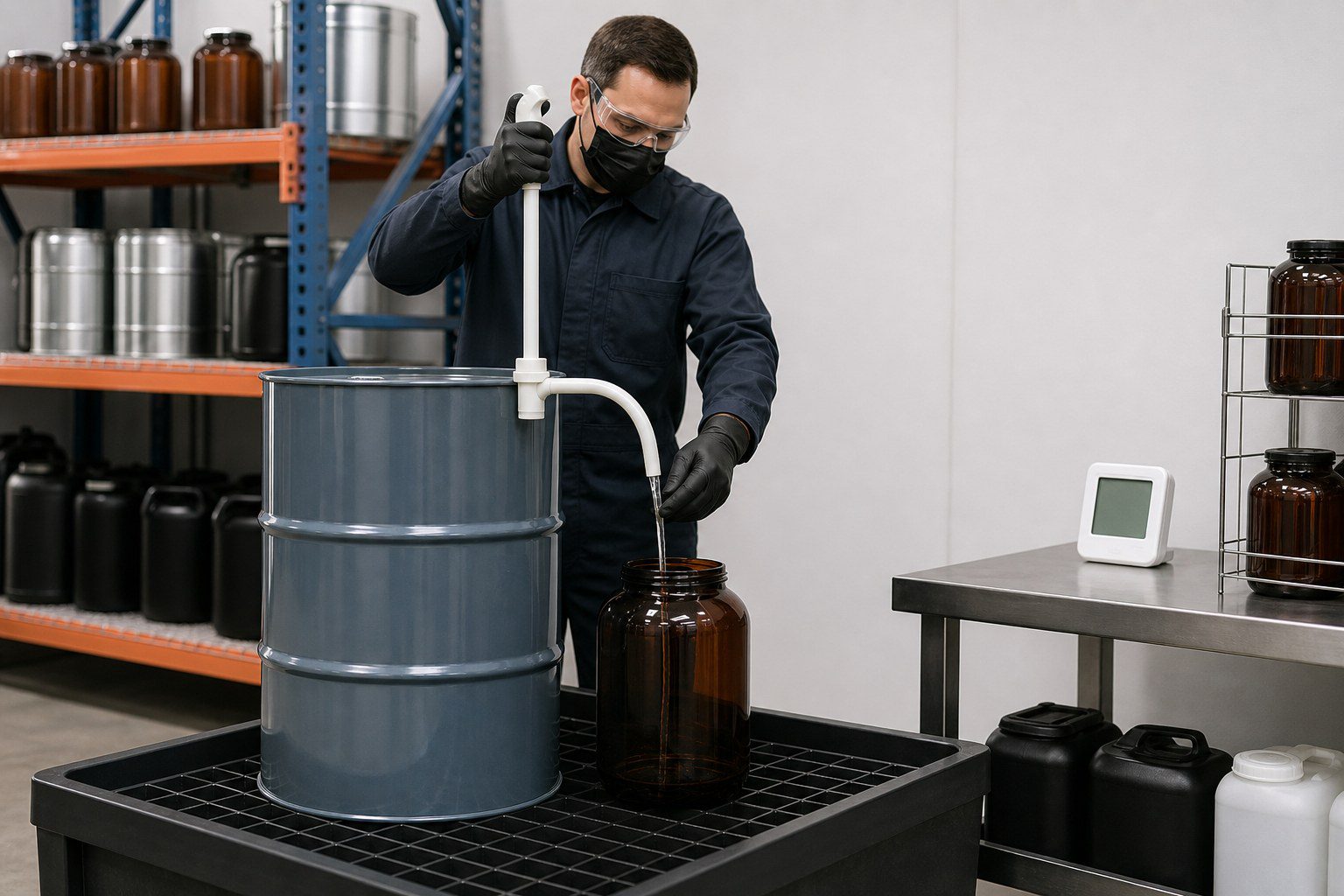
Container selection depends on the fragrance and shipment size. Amber glass is useful for laboratory samples but may be impractical for large-scale handling. Approved metal drums, fluorinated containers, or other industrial packaging may be used after compatibility review. Caps, liners, gaskets, pumps, and transfer hoses matter as much as the main container.
Never assume that every plastic is compatible with every fragrance. Some aromatic materials can migrate into, soften, stain, or permeate packaging. Validate the complete closure system for the expected contact time and temperature.
Do not extend use solely because the oil still smells acceptable. Review storage history and package integrity, then compare appearance and odor with an approved retention. Depending on the specification and risk, confirm relative density, refractive index, flash point, chromatography, or other relevant parameters.
A supplier may recommend a retest date rather than an absolute expiration date. Requalification should be documented, time-limited, and based on suitable evidence. If the container was stored incorrectly, contaminated, or cannot be traced, quarantine it until a qualified decision is made.
Not automatically. Low temperature may cause reversible crystallization, haze, viscosity change, or separation in some formulas. Refrigeration can also introduce condensation during repeated warming and cooling. Use only the storage conditions recommended for the specific product.
Fragrance oil that has changed may discolor a base, produce off-notes, reduce diffusion, or create inconsistent batches. Even correctly stored oil must still be tested in the finished product because shelf life of the raw fragrance is different from stability and shelf life of a candle, detergent, cosmetic, or diffuser.
SHEAIN supplies batch-specific documentation and can advise on handling, packaging, samples, and repeat-order planning. Buyers should use the instructions issued for the exact fragrance and destination. See our guide to IFRA, SDS, COA, and allergen documents.
It is formula- and package-specific. Use the supplier’s specification, labeled storage conditions, and retest or expiration information.
Only after a documented evaluation by qualified personnel confirms it remains within specification and suitable for the intended use.
Heat, light, oxygen, natural materials, or chemical interaction may contribute. Compare it with the approved standard and specification before deciding.
Smaller working containers can reduce repeated exposure, but the transfer system and new containers must be clean, dry, compatible, closed, and traceable.
No. The SDS communicates hazards and safe handling; use the product specification, COA, storage guidance, and quality data as well.
Contact SHEAIN with the fragrance code, batch, package, storage history, destination, and intended application.