

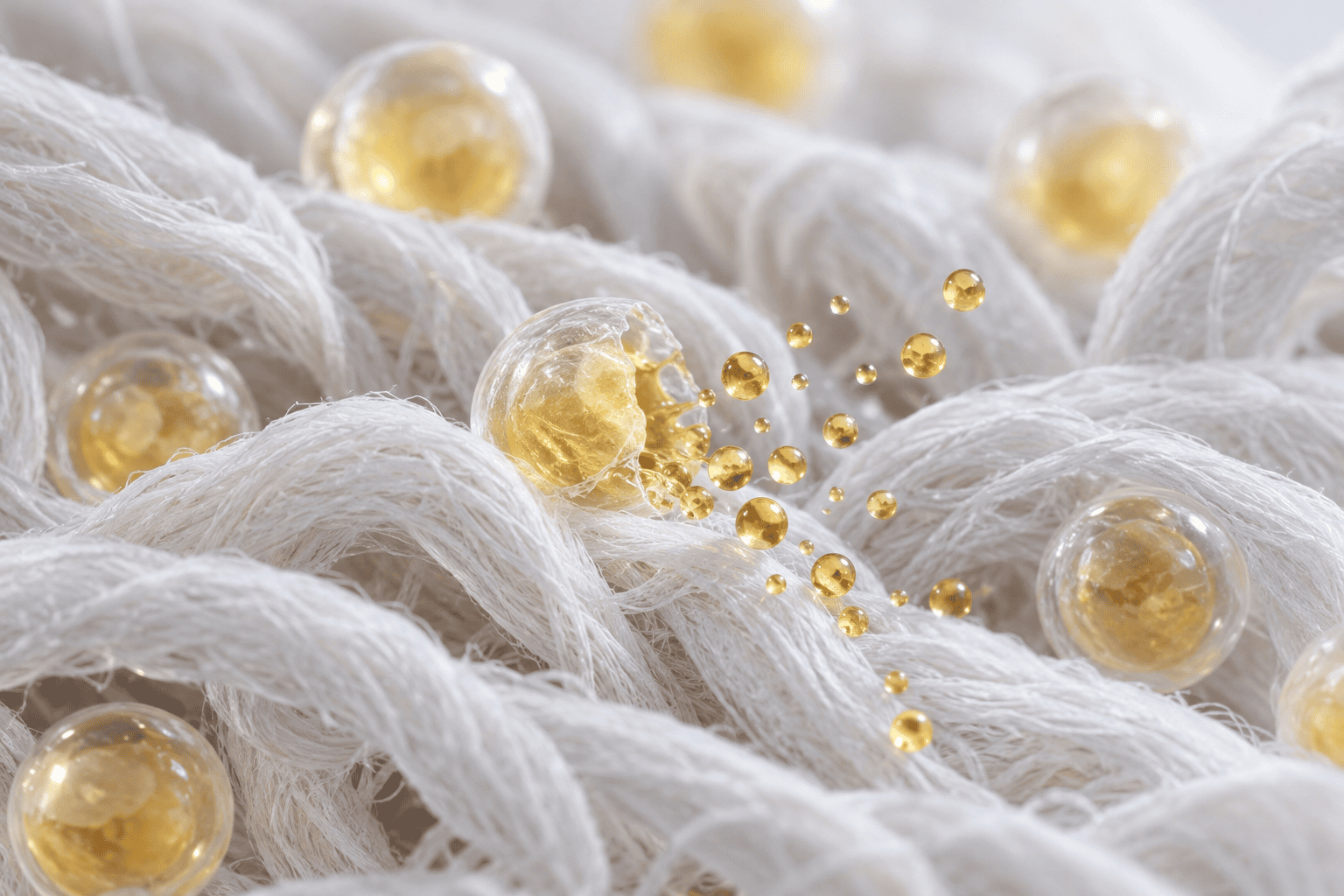
Microencapsulated fragrance for laundry packages fragrance within a capsule system intended to influence where and when scent is released. It should be evaluated as a delivery technology, not simply as a stronger perfume oil. Capsule composition, detergent or softener compatibility, fabric deposition and the user’s handling conditions all affect the result.
Define what is being supplied
SHEAIN supplies pre-encapsulated fragrance microcapsules, not only free fragrance oil for customers to encapsulate. Confirm the current supplied form, capsule composition and intended laundry application for the selected product; a generic microcapsule name does not establish compatibility or performance.
Clarify whether the sample is free fragrance, a capsule dispersion, dried capsules or a combination. Record fragrance payload and dispersion solids where the supplier provides them. Equal additions of two supplied products may deliver different amounts of fragrance. Compare on a clearly stated basis and ask about recommended handling, storage and application limits.
Encapsulated fragrance for liquid detergent: compatibility checks
When sourcing encapsulated fragrance for liquid detergent, share the complete base, pH, surfactant and enzyme system, process temperature and mixing conditions. Ask the supplier to identify the capsule product used in the sample, then agree storage and wash-test acceptance criteria before comparing quotations. Use the fragrance microcapsule supply page to prepare a product-specific sample request.
Capsules can be exposed to surfactants, solvents, pH changes and mechanical stress during manufacturing and storage. Use the actual product base and supplier-recommended addition process. Compare freshly prepared material with stored samples, looking for leakage, aggregation and changes in release behavior. More vigorous mixing is not automatically better for a capsule dispersion.
Distinguish fabric deposition from bottle strength
A strong odor in the bottle does not establish that capsules deposit on fabric. Use standardized wash and rinse conditions, matched textiles and a free-fragrance control when appropriate. Quantitative deposition requires a suitable analytical method; sensory scores alone describe perceived odor and should not be reported as a measured deposition percentage.
Evaluate before and after controlled handling
Compare dry fabrics before and after a reproducible handling or rubbing procedure appropriate to the capsule design. Keep fabric mass, drying method, storage and evaluation timing matched. Use replicates and blind sample coding. Report any increase in perceived scent without inventing an exact release mechanism if the supplier has not established it.
Review environmental and application evidence
Request documentation for the actual shell chemistry, product and destination market. A competitor’s biodegradable capsule claim does not apply to another supplier’s material. Ask what test method supports any environmental statement and what limitations apply. Avoid describing every microcapsule as biodegradable, microplastic-free or compliant based only on a marketing term.
Write the supply brief around delivery requirements
Specify the base, process shear, textile types, desired release stage and cost target. Confirm current capsule options with SHEAIN before making product claims or committing to a formulation. Keep acceptance criteria for storage stability, deposition evidence and sensory release separate so one appealing result does not hide a weakness elsewhere.
Frequently Asked Questions
Are microcapsules the same as scent booster beads?
No. A bead is a finished delivery format and may or may not contain fragrance microcapsules.
Does encapsulation guarantee longer-lasting scent?
No. Base compatibility, deposition and release conditions must be demonstrated.
Can capsule products be compared at equal dosage?
Only if the comparison accounts for differences such as fragrance payload and solids.
Does rubbing always release the scent?
Release depends on the particular capsule design and must be confirmed.
Are all fragrance capsules biodegradable?
No. Claims require evidence for the actual material and relevant test method.
Further Reading and Application Support
Research on fragrance capsule deposition provides background on this application. Manufacturer-specific recommendations apply to their own materials and equipment; the comparison procedures above are editorial guidance, not reported SHEAIN test results.
Related guide: Scent Booster Beads: Fragrance Selection, Encapsulation and Laundry Performance.
Request a laundry fragrance microcapsule sample
Review our pre-encapsulated fragrance microcapsule supply page and fabric care application guidance, then prepare a project brief:
- Base and process: detergent or softener type, available formulation information, pH, process temperature, mixing conditions and intended addition stage.
- Evaluation: textile types, wash/rinse/drying conditions, desired release stage, reference sample and agreed test criteria.
- Purchasing: target market, expected quantity, destination, required documents and target delivery date.
Ask for the selected product’s supplied form, handling guidance, shell information and available test evidence. Review SDS, IFRA conformity and other supplier documents against the actual product, fragrance and intended use. Environmental and performance claims require product-specific evidence.
Request microcapsule samples and a project quotation. Sample fees and shipping costs, MOQ, bulk transport packaging and lead time are confirmed for each project; no universal dosage or scent-duration guarantee is implied.


