
Direct answer: Treat a functional, sustainable or AI-assisted fragrance claim as a question to verify—not as proof of performance. Ask what is being claimed, which material or process it concerns, how it was assessed and whether the evidence applies to your final product. This article is a procurement evidence checklist, not a 2026 market forecast.
For basic definitions, read the functional-fragrance overview; for scent collection planning, use the sensory-brief workflow. Here the focus is deciding what documentation a claim needs before it enters a specification or marketing statement.

1. Name the Exact Functional Claim
“Functional fragrance” is too broad to approve as a specification. Separate a scent impression from a measured technical, health or commercial result.
For example, the following requests require different evidence:
- Soft or comforting scent impression → defined sensory feedback
- Sleep or stress claim → relevant health-efficacy evidence and claims review
- Odor-neutralization claim → a suitable method for the named odor and product
- Diffusion or retention claim → testing in the stated device or base
- Increased engagement → a relevant study of the actual environment
A fragrance’s name or ingredient reputation cannot establish these outcomes. Evidence must identify the tested material, conditions, endpoint and limitations.
SHEAIN’s ordinary fragrance oils are aroma materials, not automatically deodorizing, formaldehyde-removal or therapeutic actives. An application may require other functional ingredients and separate testing of the complete formulation.
2. Check the Scope of Market and Application Evidence
A market headline can inspire a product idea but does not establish demand for a particular SKU, price point or target country.
No audited market-size estimate is supplied here. Unverified forecasts should not be used to size an order or presented as measured SHEAIN sales.
If market data is used in a business case, record:
- Publisher and primary data source
- Publication date and period covered
- Country, product category and channel included
- Definitions, methodology and any forecast assumptions
- How the evidence relates to the proposed customer segment
Then validate the product idea with the buyer’s own customer and channel information. A category forecast is not a purchase commitment or a performance test.
3. Verify Sustainability and Composition Claims Separately
Define the exact attribute rather than using broad words such as “green” or “eco-friendly.” A sensory description like natural-inspired does not establish natural ingredient content or environmental performance.
Ask what evidence supports each requested attribute:
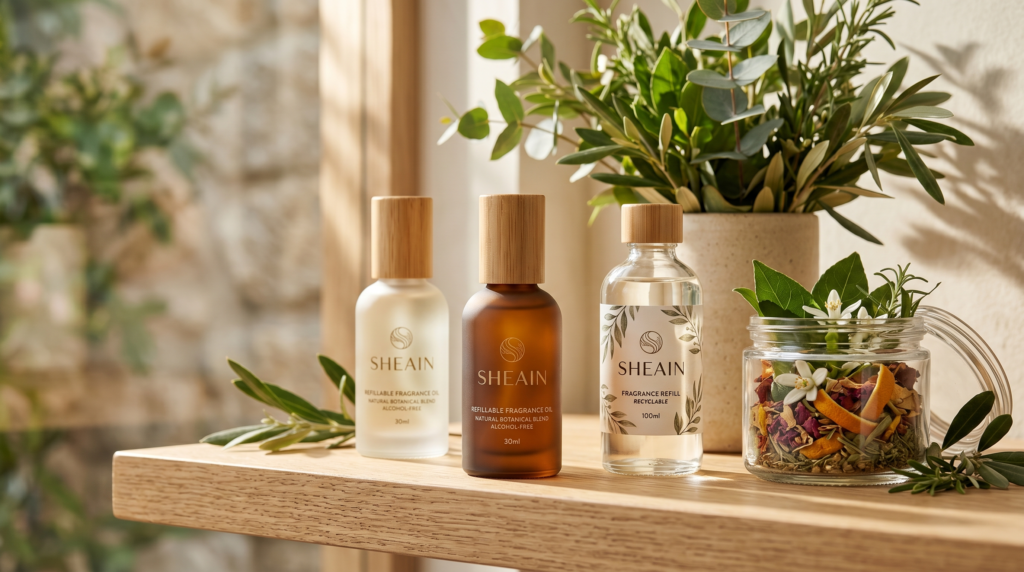
- Alcohol-free → a defined composition claim for the supplied material
- Refillable → a defined finished-packaging system and use assumptions
- Lower environmental impact → scope, baseline, method and product-level relevance
- Natural content → a stated definition and relevant composition information
- Allergen statement → the named framework and current formula data
Alcohol-free does not by itself mean skin-safe, non-allergenic or suitable for leave-on use. Natural origin and pleasant smell are also not substitutes for a product safety review.
Likewise, a packaging feature is not a property of the fragrance concentrate. Keep ingredient, manufacturing-process, packaging and finished-product claims distinct.
4. Ask What AI-Assisted Development Actually Means
If a supplier describes a fragrance as AI-assisted, ask which development step uses the tool. Do not assume SHEAIN uses a particular platform or that the label proves a validated formula.
Useful questions include:
- Was the tool used for ideation, preference analysis or formula suggestions?
- Which person approved the proposed formula?
- Which source data and restrictions were reviewed?
- Was the candidate assessed in the intended application?
- How are formula versions, confidentiality and changes controlled?
A digital prediction is not an application test, an IFRA assessment, a safety data sheet or a clinical trial. Ask for the actual approval record rather than a technology label.
No AI-generated performance result or claim of shortened SHEAIN development time is asserted in this article.
5. Match Evidence to the Actual Purchase
Before release, the procurement file should distinguish:
- The fragrance code and approved formulation revision
- The intended base/device, dosage and target market
- The relevant document versions and batch specification
- The proposed claims, evidence and unresolved limitations
- The supply scope, change-control owner and quotation
Do not fill missing evidence with a generic assurance. If an application has not been verified, record it as requiring project evaluation rather than approved.
SHEAIN mainly supplies fragrance oil concentrate. Submit a defined brief so sample, documentation and commercial scope can be confirmed. Sample fees and freight are project-specific; any exclusive rights or limited finished-product scope require separate agreement. Discuss your evidence requirements.


