

Long-lasting laundry fragrance is created through formulation, deposition, and controlled release—not simply by adding more fragrance oil. A scent must survive storage, washing, rinsing, drying, and repeated handling while remaining compatible with the detergent or softener base.

Why Laundry Fragrance Fades
During washing, fragrance materials are diluted and exposed to surfactants, enzymes, alkalinity, temperature, and agitation. Volatile notes can disappear quickly, while materials with poor fabric affinity leave with the wash water. Heat and airflow during drying create further losses.
The Wash–Rinse–Dry–Wear Journey
- In the package: remain stable throughout shelf life.
- During washing: tolerate the chemical environment and dilution.
- During rinsing: deposit selected materials onto fibers.
- During drying: retain a pleasant profile after heat or airflow.
- During wear: release residual fragrance gradually.
1. Start With Base Compatibility
Evaluate fragrance in the actual detergent, powder, conditioner, or booster. Surfactant type, pH, enzymes, solvents, preservatives, water content, and packaging can affect odor, clarity, color, and stability. Performance in one base does not guarantee performance in another.
2. Build a Balanced Fragrance Structure
Fresh citrus, green, and airy notes create an attractive opening but can be volatile. Longer-lasting heart and base materials help maintain character after washing and drying. The objective is immediate freshness plus a recognizable dry-fabric signature.
3. Improve Deposition on Fabric
Fabric softeners often support stronger deposition because of their interaction with fibers during rinsing. Fragrance design should account for fiber type, conditioner system, dosage, and the desired after-dry profile.
4. Consider Microencapsulated Fragrance
Microcapsules protect selected materials and release them through friction, movement, or other triggers. They can extend the scent experience, but compatibility, deposition, stability, regulatory suitability, and environmental requirements require professional review.

5. Optimize for Each Product Format
Liquid detergent
Focus on surfactant compatibility, storage stability, and wet-wash character.
Laundry powder
Consider alkalinity, moisture, processing conditions, and retention in a dry matrix.
Fabric softener
Evaluate deposition, viscosity, emulsion stability, and dry-fabric performance.
Fabric spray or scent booster
Check solubility, spray behavior, spotting risk, packaging compatibility, and release.
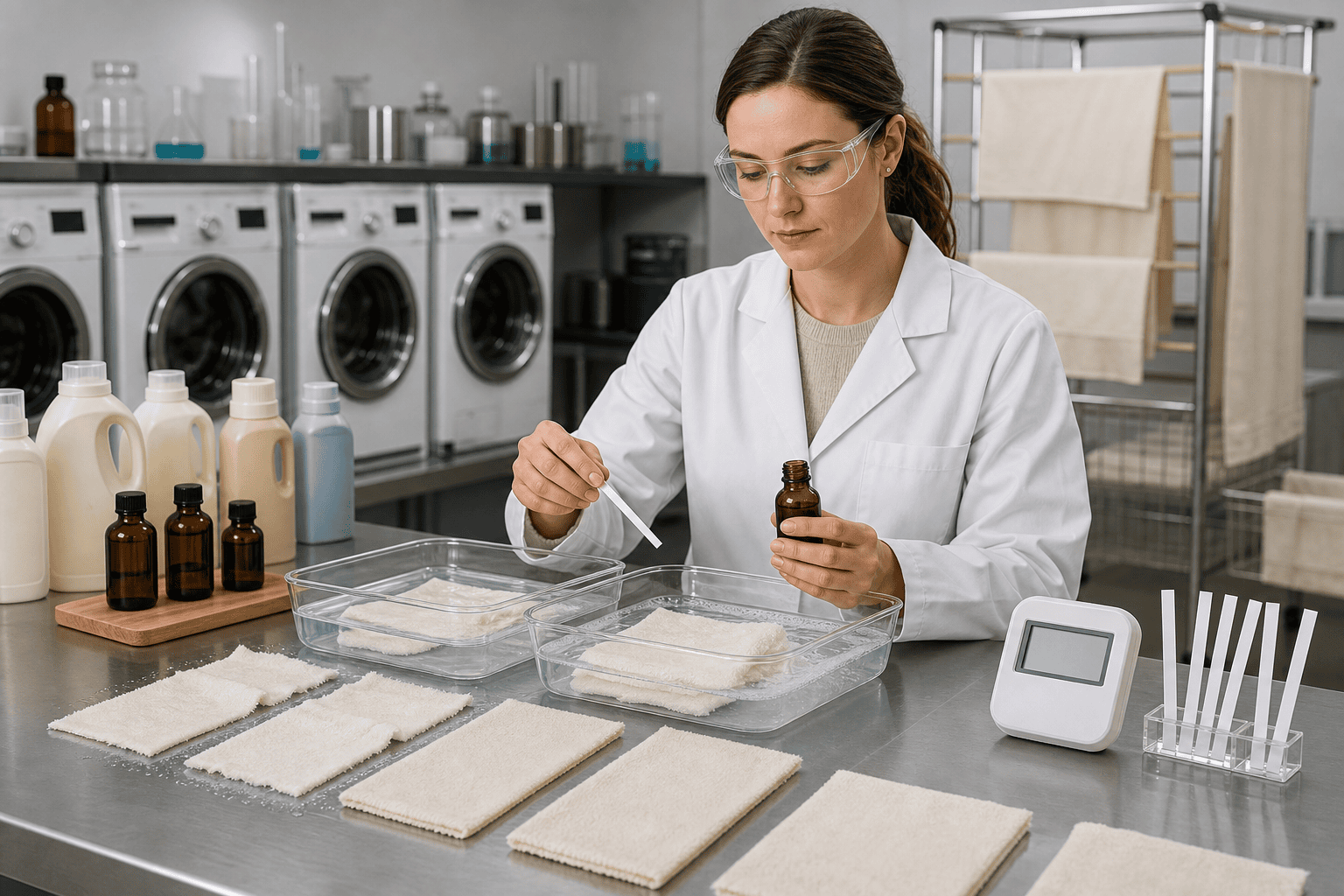
6. Run a Practical Performance Test
- Prepare a control and several dosage variants.
- Evaluate initial odor, color, clarity, pH, and viscosity.
- Conduct accelerated and real-time storage checks.
- Wash standardized fabric loads under repeatable conditions.
- Assess wet, dried, and stored fabric.
- Use a trained panel and document intensity and character over time.
7. Optimize Fragrance Dosage
The best dosage is the lowest level that achieves the required consumer experience while maintaining stability, cost efficiency, and compliance. Increasing fragrance concentration can change viscosity, clarity, foam, color, or emulsion stability. It can also make the opening overpowering without improving scent on dry fabric.
Build a dosage ladder in the actual base and compare both package odor and post-wash performance. The final level should be reviewed against the relevant IFRA category and destination-market requirements.
8. Match the Fragrance to Fabric and Drying Conditions
Cotton, polyester, blended fabrics, and towels do not retain fragrance in exactly the same way. Line drying and machine drying also create different volatility and heat exposure. Testing only one fabric under one condition may produce a misleading conclusion.
Use fabrics and washing habits representative of the target consumer. For products sold internationally, consider water hardness, wash temperature, machine type, detergent dosage, and common drying methods in the priority markets.
9. Protect Quality During Storage
Laundry products may spend months in a warehouse, shipping container, retail store, or consumer home. Evaluate the formula at relevant temperatures and in the intended packaging. Monitor odor character, color, separation, viscosity, pH, and package interaction.
If a fragrance changes significantly during accelerated testing, investigate the complete system. The cause may be oxidation, interaction with the base, packaging permeability, light exposure, or an unstable ingredient—not simply insufficient fragrance dosage.
Conventional Fragrance and Microcapsules Can Work Together
Many products use free fragrance for an immediate package and wash experience, combined with encapsulated fragrance for later release on dry fabric. The balance depends on the desired consumer journey and product format. More technology is not automatically better; the system must deliver a coherent scent from bottle to wear.
Buyer Checklist for Laundry Fragrance Development
- Share the complete base or a representative unfragranced sample.
- Define the target dosage and IFRA application category.
- Identify the benchmark scent and desired dry-fabric character.
- Specify target fabrics, wash cycles, water conditions, and drying methods.
- Agree on storage and compatibility tests before approval.
- Compare multiple production batches where possible.
- Confirm SDS, IFRA, COA, and allergen documentation.
Common Causes of Weak Performance
- Using fragrance designed for another application
- Overreliance on volatile top notes
- Poor surfactant or enzyme compatibility
- Insufficient fabric deposition
- No testing after drying and storage
- Increasing dosage without checking stability or permitted use
Custom Laundry Fragrance Development
A strong brief identifies format, base composition, target market, dosage, scent family, benchmark, drying method, price position, and longevity target. SHEAIN develops fragrances for detergent, powder, conditioner, refresh sprays, and microcapsule systems. Explore our fabric care solutions and guide to fabric care fragrance.
Frequently Asked Questions
Does more fragrance always last longer?
No. Excess dosage may cause instability, cost, or compliance problems without improving deposition.
Is microencapsulation required?
No. It is one option. A well-designed conventional fragrance may also perform strongly.
How should longevity be measured?
Evaluate after washing, drying, and defined storage periods under consistent conditions.
Why does a fragrance smell strong in the bottle but weak on fabric?
Package odor and fabric deposition are different performance stages. Volatile materials may smell strong initially but wash away or evaporate during drying.
Can the same fragrance be used in detergent and softener?
It may be possible, but each base requires separate compatibility, stability, dosage, and performance testing.
Request Laundry Fragrance Samples
Contact SHEAIN with your base type and performance target.


