

Fragrance oil for nebulizing diffuser systems should be selected against the actual pump, nozzle and operating program. A waterless system may disperse an oil-based liquid directly, so the carrier and fragrance blend influence both delivery and maintenance. The useful purchasing question is whether the oil provides consistent room scent at an acceptable consumption rate in the intended equipment.
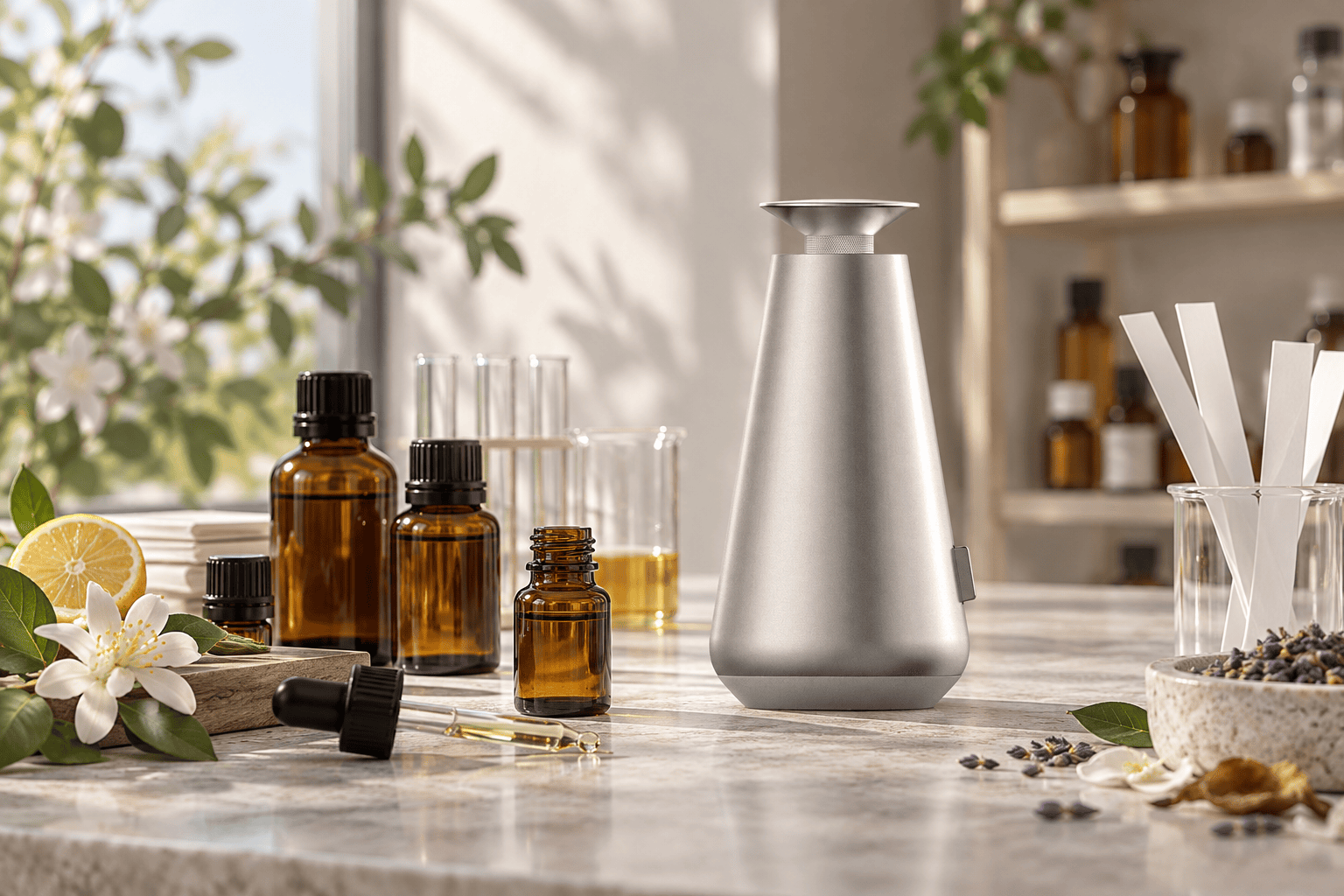
Confirm the exact delivery system
Record the device model, reservoir, nozzle arrangement and approved oil specification. A tabletop unit and a large commercial machine can respond differently to the same liquid. Confirm whether the sample is a ready-to-use diffuser oil or a concentrate requiring an approved carrier. Do not add water, alcohol or another diluent without the equipment and formulation suppliers’ guidance.
Check flow at the operating temperature
Compare appearance and flow at representative storage and room temperatures. If viscosity is measured, record the method and temperature with the result; an isolated number is not a universal equipment specification. Ask the device supplier for an acceptable operating range. Changes in nozzle design, pumping and cycle duration can alter output even when measured viscosity is similar.
Measure consumption over complete operating cycles
Weigh the reservoir assembly consistently before and after a defined test period, keeping caps and components identical. Record programmed on-time and total elapsed time. For example, a hypothetical 12 g loss across eight elapsed hours equals 1.5 g per elapsed hour. That calculation is a reporting example, not a SHEAIN performance claim. Check for leakage before interpreting all mass loss as atomized fragrance.
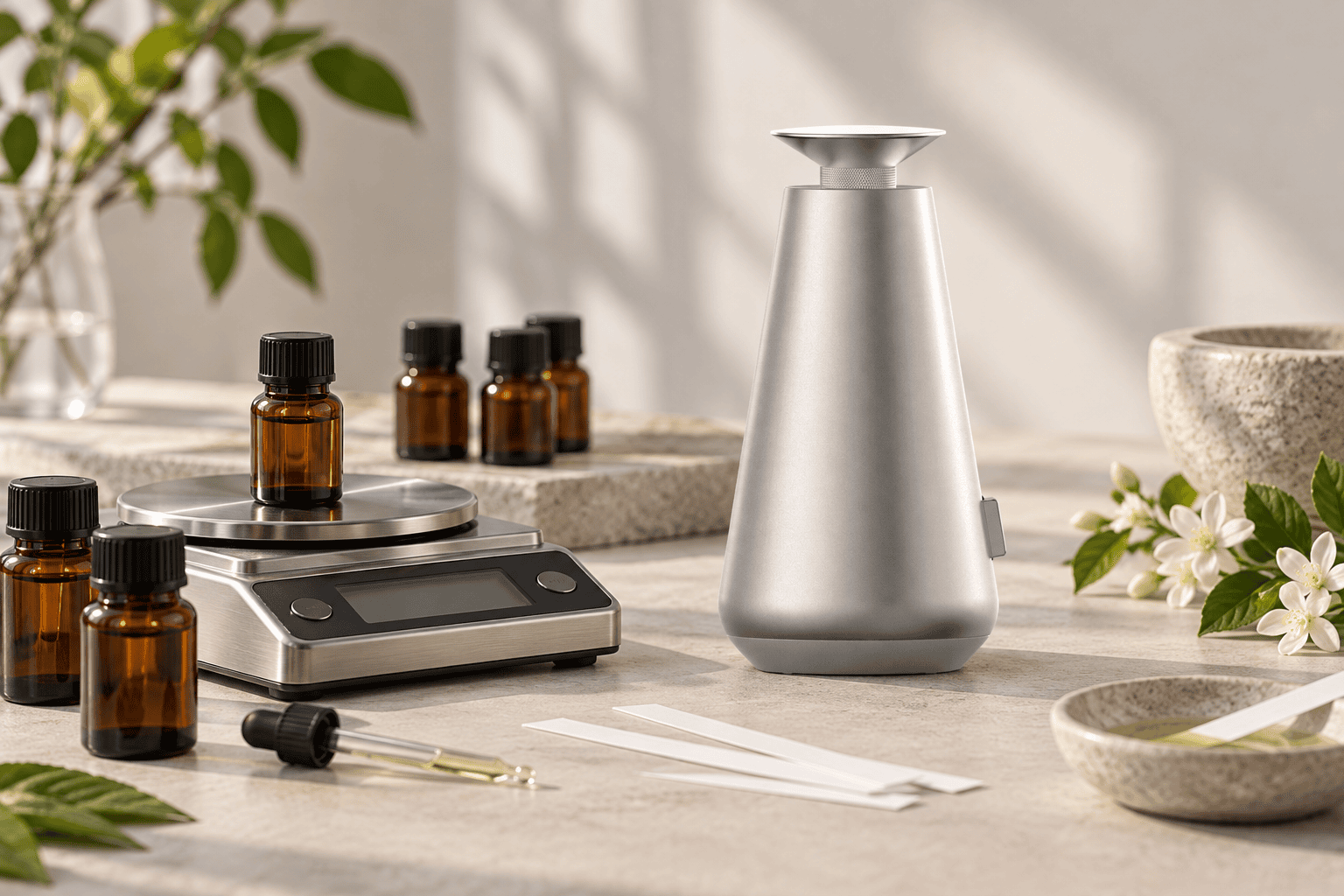
Evaluate room scent at a fixed program
Use the intended room volume, ventilation and placement. Score intensity at multiple locations after a consistent settling period; alternate assessors or allow recovery time to limit adaptation. Do not compare one sample on a high setting with another on a low setting. If a candidate needs a different program, report both the sensory result and the corresponding consumption.
Test restart and service behavior
Include normal rest periods and restarts in the evaluation. Observe output consistency, noise changes, nozzle wetting and deposits over repeated runs. Follow the manufacturer’s maintenance instructions and compare performance before and after cleaning. Avoid declaring a universal cleaning interval from a short laboratory trial: usage, formulation and environment all matter.
Approve oil and device as a combination
Retain the approved fragrance batch, device settings and test record together. Compare cost per useful operating hour rather than price per kilogram alone. Send SHEAIN the machine specification, application, odor brief and consumption target when requesting samples. The resulting approval applies to that combination; it is not an endorsement for every nebulizer.
Frequently Asked Questions
Is a nebulizing diffuser the same as an ultrasonic diffuser?
No. Waterless nebulizing equipment and water-filled ultrasonic equipment use different delivery systems.
What is the best viscosity?
There is no single value for all machines. Use the equipment specification and a defined measurement temperature.
Can consumption be compared by bottle level?
Mass measurements under a consistent procedure are usually easier to compare than visual bottle levels.
Does higher output mean better room scent?
Not necessarily. Excessive output can increase consumption without improving the desired room experience.
Can the oil be diluted to improve flow?
Only with a carrier and formula approved for the specific equipment and use.
Further Reading and Application Support
Cold-air delivery principles provides background on this application. Manufacturer-specific recommendations apply to their own materials and equipment; the comparison procedures above are editorial guidance, not reported SHEAIN test results.
Related guide: Aroma Diffuser Oil Viscosity: Why It Matters for Atomization and Coverage.
Contact SHEAIN with your formulation, application and fragrance brief to discuss suitable samples.
