

Fragrance oil for paraffin candles needs to match the paraffin grade and candle format. Container blends, pillar waxes and modified paraffin systems do not behave identically. Evaluate the fragrance in the finished system rather than assuming that a clear molten blend will remain suitable after cooling and storage.
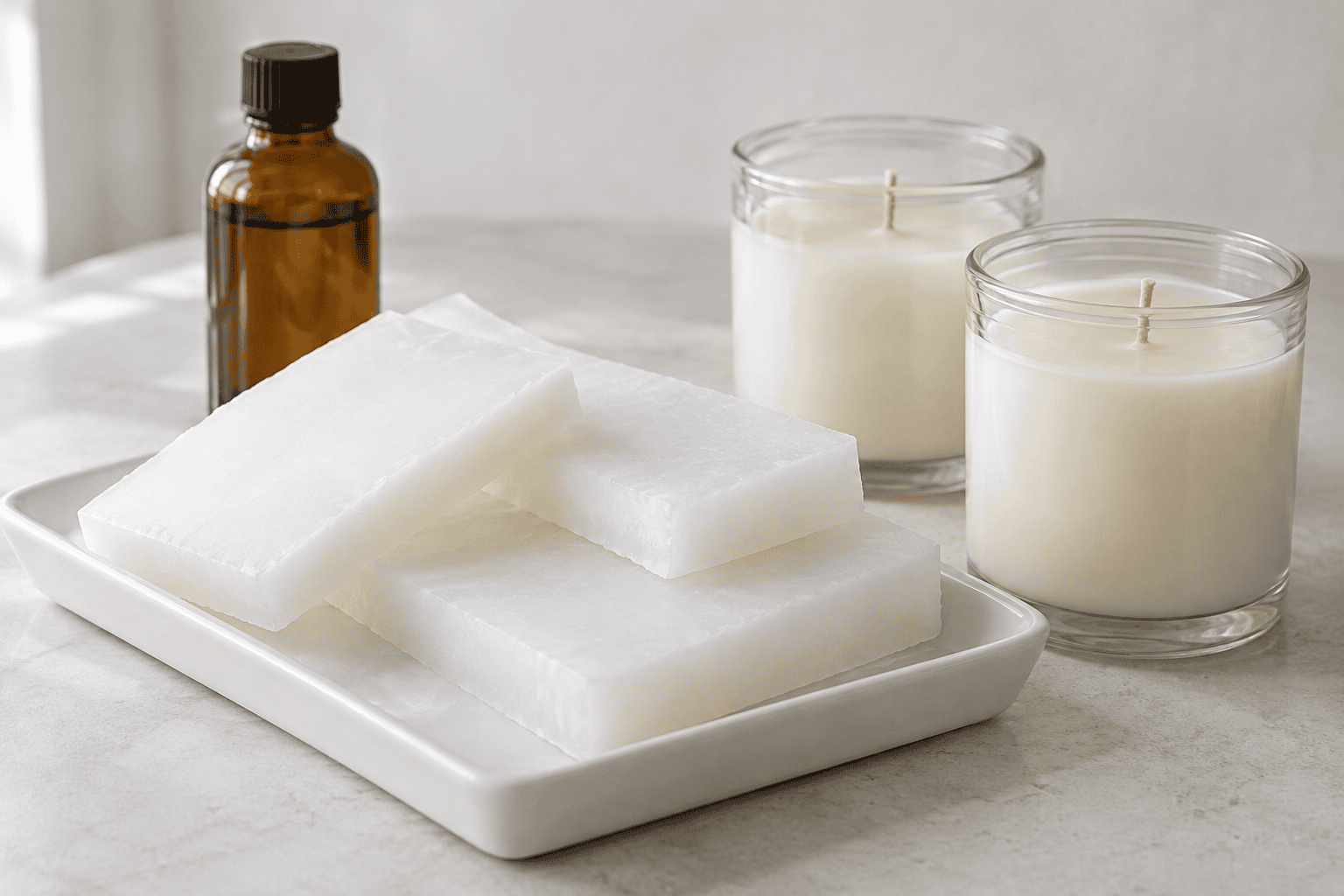
Distinguish container and pillar applications
Specify the wax grade and whether the candle is designed for a container or free-standing use. Include supplier-approved additives already present in the formula. Oil retention, firmness and processing needs can differ by grade. A fragrance supplier needs this information before recommending candidates or interpreting an apparent compatibility failure.
Inspect the molten blend and the cooled candle
Follow the wax supplier’s mixing procedure and observe uniformity without assuming that visual clarity proves long-term stability. After cooling, check the surface, base and container contact areas for oil movement. Keep matched samples for storage observation. Separation that appears later can be missed if approval is based only on the pour-day result.
Keep processing variables under control
Use weighed quantities, a documented temperature sequence and consistent agitation. Record any dye or additive because changes can affect the candle system. When investigating failure, change one factor at a time. Repeatedly adding ingredients to rescue a batch produces a difficult-to-interpret mixture and makes supplier troubleshooting less useful.

Evaluate the wick with the fragrance present
Test the selected fragrance in the intended vessel or pillar dimensions and wick configuration. Observe flame stability, melt behavior, visible soot and other criteria in the established burn protocol. Fragrance composition can change the system response; an unfragranced candle is a useful control but not a replacement for testing the sale formula.
Compare scent under repeatable conditions
Use the same room, ventilation, candle age and evaluation interval for candidates. Record the recognizable scent character, intensity and any unpleasant burned impression. Include checks later in candle life. When one candidate appears stronger, verify that the difference is not simply a different wick response or a different test-room condition.
Document the approved production specification
Retain the approved formula, wax and fragrance batches, wick code, process and finished samples. For a change of fragrance or wax supplier, repeat the relevant compatibility and burn checks. Send SHEAIN the paraffin grade, candle format, fragrance direction and target market so the sample request is tied to the real application.
Frequently Asked Questions
Does paraffin accept every candle fragrance?
No. Compatibility must be checked in the particular grade and finished candle.
Is a clear melted mixture enough?
No. Inspect the cooled candle and stored samples for separation and other changes.
Can soy candle settings be copied?
They are not automatically transferable to a paraffin system.
Should the wick be checked after changing scent?
Yes. Reassess the finished candle when the formulation changes.
What should a sample request include?
Provide wax grade, format, wick, process, appearance target and fragrance direction.
Further Reading and Application Support
Candle wax types and blends provides background on this application. Manufacturer-specific recommendations apply to their own materials and equipment; the comparison procedures above are editorial guidance, not reported SHEAIN test results.
Related guide: Candle Fragrance Load Testing: Cold Throw, Hot Throw and Burn Performance.
Contact SHEAIN with your formulation, application and fragrance brief to discuss suitable samples.


