

Reed diffuser base compatibility determines whether fragrance oil, solvent and reeds work together to produce stable, controlled scent diffusion. A fragrance that smells excellent on a blotter can diffuse poorly, separate, discolor or evaporate too quickly when paired with the wrong base or wick system.

What Is Reed Diffuser Base Compatibility?
Compatibility is the combined performance of fragrance concentration, solvent polarity, viscosity, evaporation profile and reed structure. It must be evaluated as a complete system in the intended bottle and environment. A clear blend is useful, but clarity alone does not prove good diffusion.
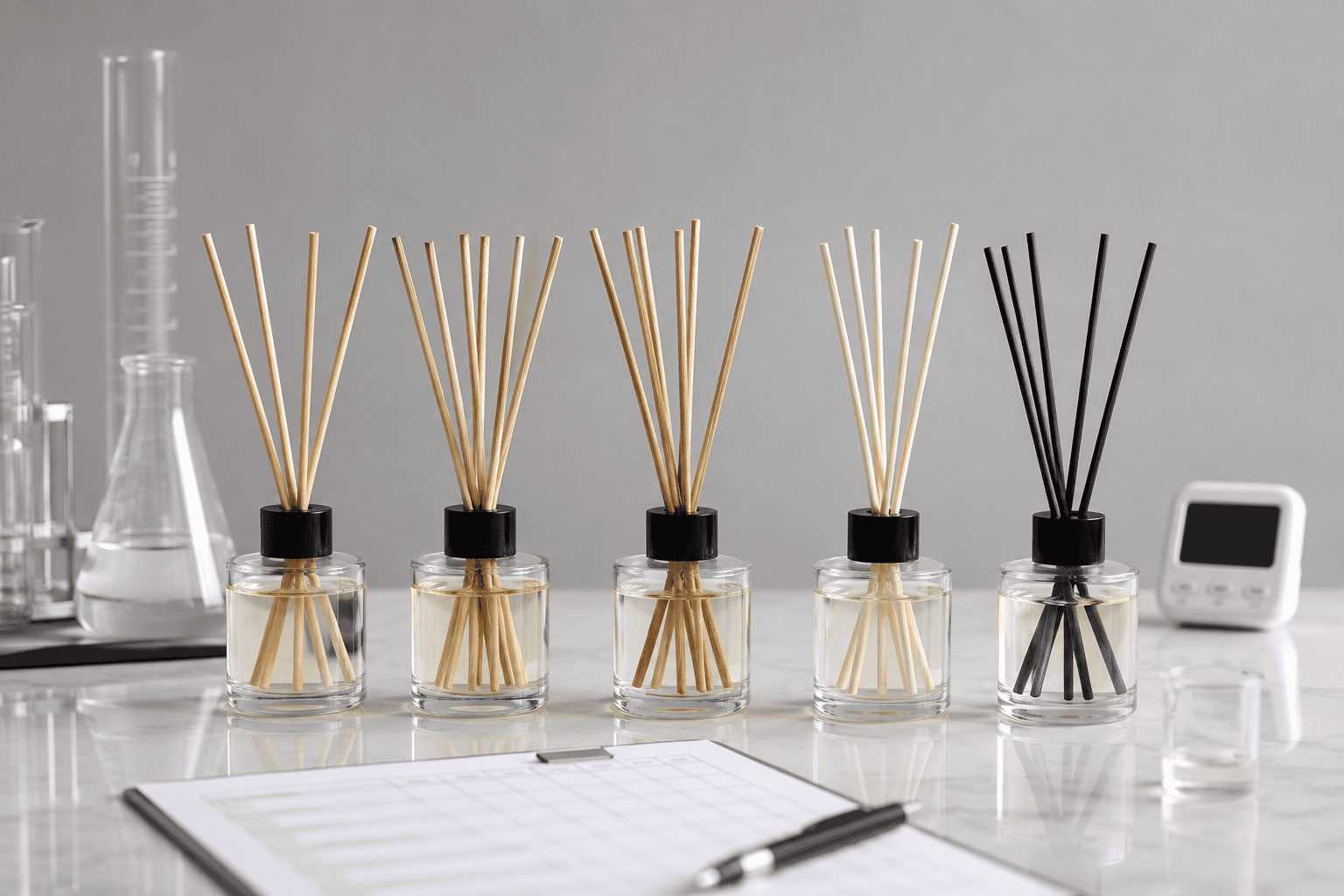
| Component | Main function | Risk to evaluate |
|---|---|---|
| Fragrance oil | Provides odor character | Solubility, color and evaporation balance |
| Diffuser base | Carries fragrance into the reeds | Viscosity, volatility and regulatory fit |
| Reeds | Move liquid by capillary action | Diameter, porosity, count and clogging |
| Bottle/closure | Controls exposed surface and storage | Neck size, leakage and material interaction |
Why Solvents and Reeds Must Be Tested Together
A lower-viscosity base may travel through reeds more easily but can evaporate faster. A heavier system may last longer yet produce weak diffusion. Fiber reeds and natural rattan can behave differently, while colorants or less-volatile fragrance materials may accumulate and slow transport.
A Practical Reed Diffuser Test Protocol
- Select the final bottle, base and reed type.
- Prepare several fragrance concentrations plus a control.
- Record initial clarity, color, odor and fill weight.
- Use identical reed count, length and exposed surface.
- Measure weight loss at consistent intervals.
- Evaluate scent intensity at fixed distance and room conditions.
- Inspect for separation, discoloration, clogged reeds and bottle interaction.
- Repeat under representative temperature and airflow conditions.

Evaporation Rate Is Not the Same as Scent Strength
A product can lose liquid quickly without creating the preferred fragrance experience. Record both mass loss and sensory intensity. High-volatility notes may dominate at first, while the remaining blend becomes heavier over time. Evaluate the scent profile at the beginning, middle and end of product life.
Room Conditions and Consumer Use
Temperature, air conditioning, sunlight, room volume and how often reeds are flipped can change performance. Define a standard laboratory method, then validate it in representative rooms. Avoid promising one exact duration for every climate and user.
Safety and Documentation
Review applicable fragrance-use guidance, the finished mixture’s classification and destination labeling requirements. The diffuser manufacturer is responsible for evaluating the final base, package and product. See our aroma diffuser fragrance solutions and compatibility-testing guide.
How SHEAIN Supports Diffuser Development
SHEAIN can develop fragrance samples around the selected diffuser base and target diffusion profile, then revise them using weight-loss and sensory results. Send us your base, bottle, reeds and target market.
Frequently Asked Questions
What is the best fragrance percentage for a reed diffuser?
There is no universal percentage. The base, fragrance, reeds, bottle and desired duration must be tested together.
Why does a diffuser blend become cloudy?
The fragrance and base may have limited solubility, especially after temperature changes.
Why do reeds stop working?
Low capillary flow, heavy materials, dust, colorants or accumulated residue may restrict transport.
Does faster evaporation mean stronger diffusion?
No. Liquid loss and perceived scent strength should be measured separately.
Can one diffuser formula work in every country?
Climate, regulations, room conditions and consumer practices can require separate validation.


