

Reed diffuser olfactory fatigue is a useful everyday description for noticing less scent after repeated exposure. It is not proof that the diffuser has stopped working. Actual output can also change. Compare the observer, product and room separately before increasing fragrance concentration or replacing a formula that may still be performing as intended.

Treat adaptation as a possibility, not an instant diagnosis
Research by Dalton and Wysocki examined changes in odor perception following longer-term exposure. Dalton and Wysocki: long-term odor exposure and adaptation The practical lesson is limited but important: a person’s reduced perception is not, by itself, a measurement of the amount of fragrance in the air. A room scent can become less noticeable to a regular occupant. However, that does not rule out changes in the product or the room, and it does not establish a fixed recovery time for every person.
Collect the complaint before changing anything
Record who notices the decline, whether they spend long periods in the space, when the change became apparent and whether visitors report the same experience. Note the diffuser age, location, reed setup and any recent changes in ventilation or room use. Do not flip reeds, add oil and move the bottle simultaneously before recording the starting condition. That would make it difficult to understand which change affected the result.
Introduce a fresh observer without leading the answer
Where suitable, ask someone who has not been spending time in the scented room to describe the odor at a defined location. Do not first tell them that the diffuser is weak. Compare their independent observation with the regular occupant’s report. A difference is a reason to investigate adaptation, not a definitive diagnosis. Repeat under comparable conditions and avoid treating one visitor’s preference or sensitivity as an objective output measurement.
Compare an in-use sample with a fresh matched reference
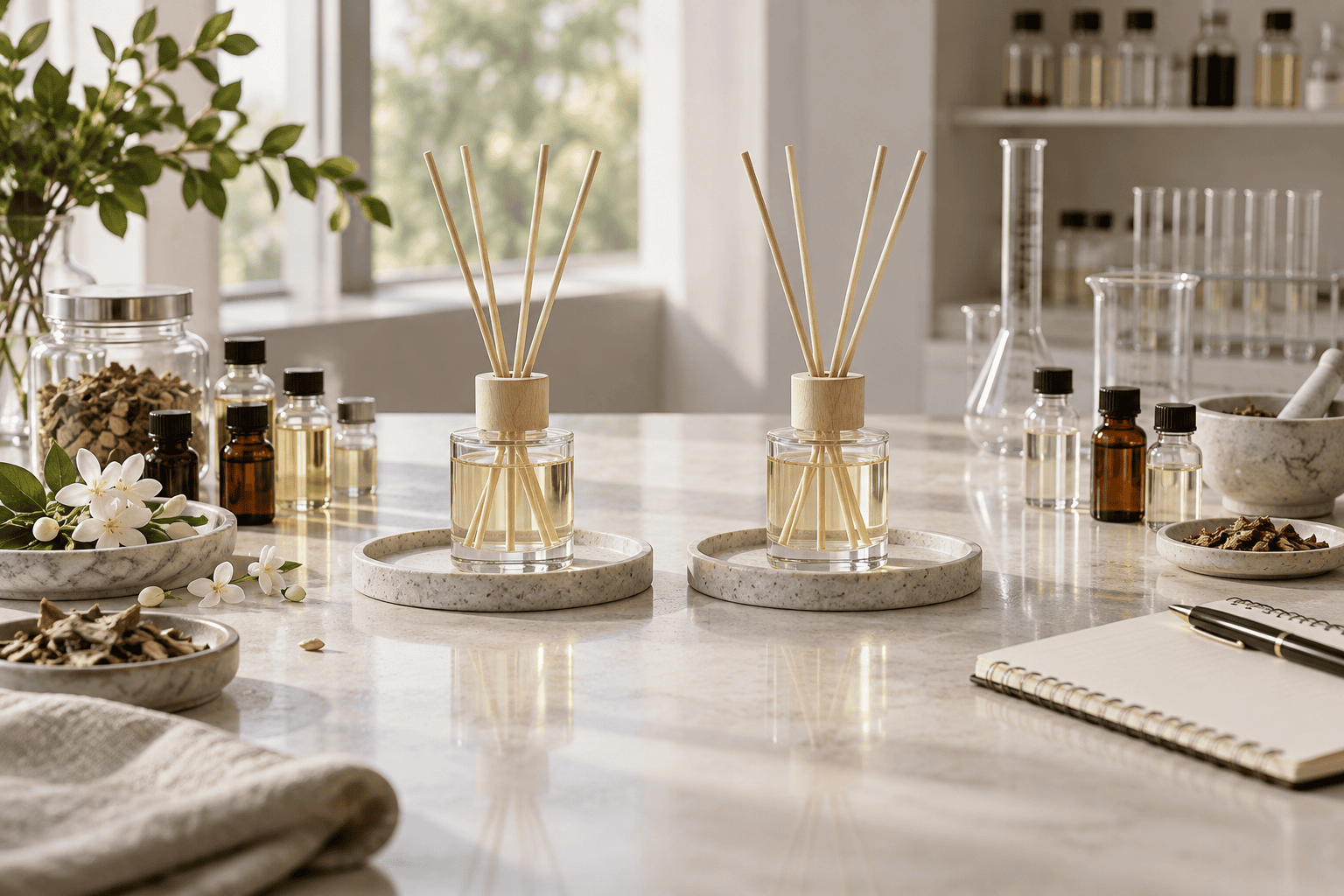
Use a properly prepared fresh reference of the same approved formula and a documented reed setup. Compare under suitable separate conditions so the samples do not scent the same space simultaneously. Ask whether several observers detect a consistent difference between the products. If both seem weak only in one room, examine the room context. If the in-use sample is repeatedly weaker across observers and conditions, investigate product aging or delivery using the separate technical compatibility procedure.
Keep sensory impressions and physical measurements separate
A mass-loss record can describe liquid consumption, but it does not directly measure perceived scent strength. A retained liquid level does not establish that the intended fragrance character is still reaching the room. Keep the records side by side: product age and condition, room observations, independent sensory descriptions and any suitable physical measurements. This helps prevent a change in perception from being mistaken for a universal formulation failure.
| Observation | Next question |
|---|---|
| Regular occupant reports weak scent; fresh observers notice it | Could repeated exposure explain part of the difference? |
| In-use sample is weaker than a fresh reference across observers | Has the product or delivery changed? |
| Both samples are weak only in one location | What differs in that room or position? |
| Liquid consumption is normal but character seems different | Which scent attributes changed, and at what product age? |
Use the evidence to choose the next action
If the main difference is between a regular occupant and fresh observers, do not automatically increase output; that may make the space unpleasant for newcomers. If the product itself has changed, send SHEAIN the fragrance code, carrier, reed details and comparison record for discussion. If the room is the main variable, review the application context. Avoid promising a stronger formula until the actual cause of the complaint has been narrowed.
Frequently Asked Questions
Does leaving the room prove whether adaptation is involved?
A break can be part of a comparison, but one re-entry observation is not a definitive test.
Should I add more fragrance when I stop noticing it?
Not automatically. Check fresh-observer and matched-product observations before changing the formula or output.
Can adaptation and a declining diffuser happen together?
Yes. The observer and product can both change, which is why the comparison should separate them.
Related Guides and Application Support
- Reed Diffuser Base Compatibility: Solvents, Wicks and Evaporation Rate
- Fragrance Sensory Evaluation: How to Build a Reliable Sample-Scoring Process
Contact SHEAIN with your end-use application, target market and scent brief to discuss fragrance oil concentrate samples.


