

Diffuser fragrance at different duty cycles should be assessed with the actual on/off program, not a vague low or high setting. This article concerns repeated operating pulses and pauses during normal use, not restarting after long storage. Compare the fragrance experience and consumption under documented conditions. A preferred concentrate on a blotter cannot establish how the complete device-and-liquid system behaves throughout each programmed cycle.
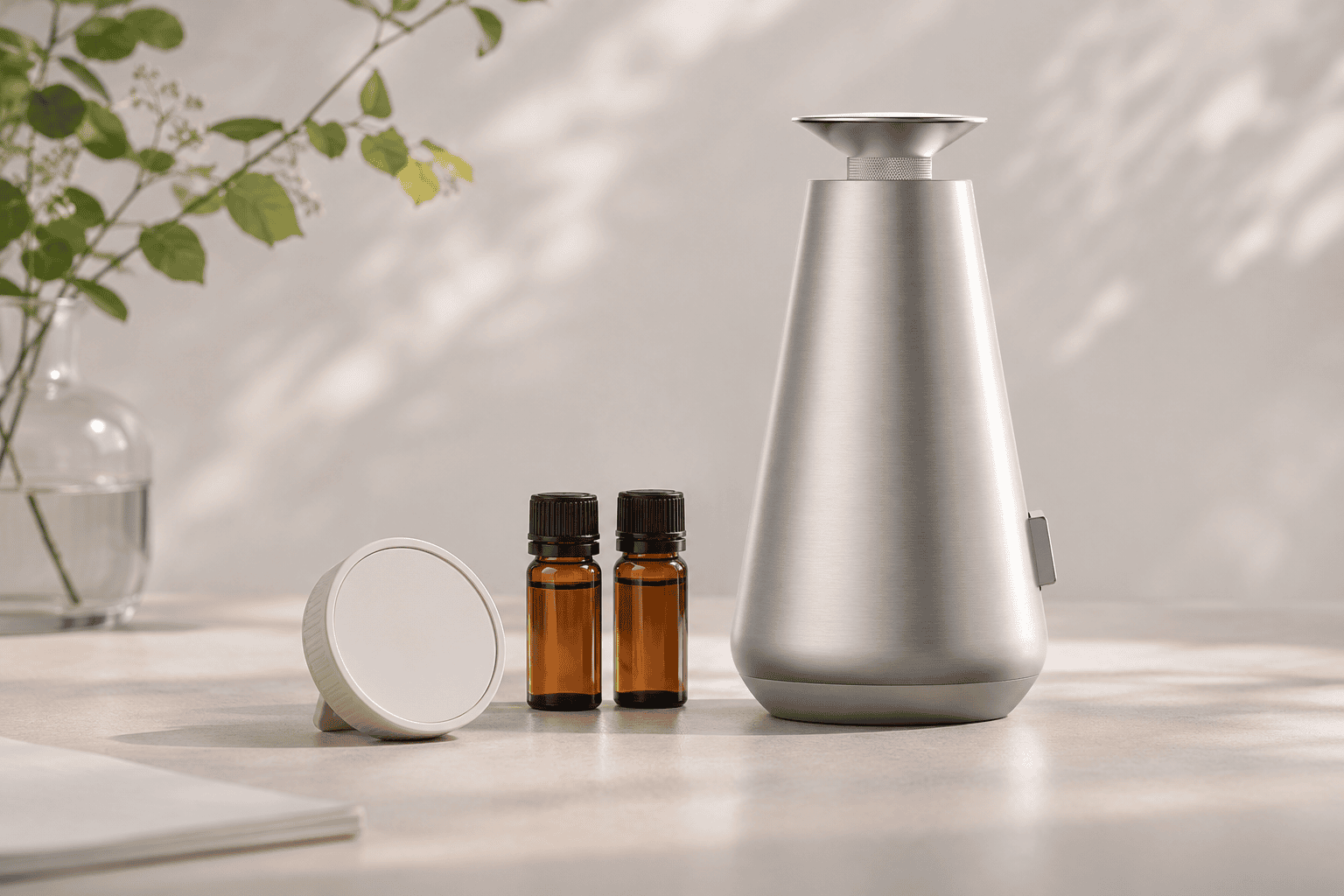
Translate each setting into the actual operating program
A MUJI manual specifies different spray-and-pause sequences for one particular diffuser model.Source: MUJI: one model’s operating-cycle instructions Those values belong to that model and must not be copied to another machine. Obtain the approved instructions for your actual equipment and record active time, pause time, operating window and mode. Confirm which liquid the manufacturer permits before testing; changing a timer does not make an unapproved liquid compatible.
Separate operating time from elapsed time
If one candidate runs for longer during the same hour, a stronger room impression may reflect the program rather than a better fragrance. Record both elapsed evaluation time and cumulative active time. State the comparison question in advance: performance at identical settings, or the settings each approved system needs to meet a target. Both can be useful, but they answer different purchasing questions and should not be combined.
Observe the beginning and end of the pause
Evaluate the room impression at agreed points around the operating cycle, not only immediately after a pulse. Record whether scent character and intensity meet the intended target throughout the interval. Use matched location, ventilation and evaluator procedure as far as practical. Do not invent a universal ideal pause; acceptable performance depends on the intended space, equipment, liquid and the product’s reviewed conditions of use.
Measure consumption alongside the scent experience
Use a consistent weighing method and record the initial fill, final mass and actual operating duration. Do not assume consumption scales perfectly with a timer percentage or that a lower setting always gives the best value. A reduced use rate is useful only if the target experience and other requirements are met. Distinguish liquid loss from proven airborne delivery efficiency; they are not automatically the same measurement.
Keep compatibility independent from a strong pulse
Check the system for unaccepted visible changes, deposits, leakage or irregular behavior under the reviewed procedure. Stop anomalous operation and consult the relevant suppliers rather than increasing output to overcome it. The table is an original comparison plan, not device certification or SHEAIN test data. Safety, material compatibility and the exact liquid specification require separate approval; no operating result establishes universal compatibility across diffuser technologies.
| Record | Comparison question | Avoid |
|---|---|---|
| Cycle | Exact active and pause durations? | Using low/high without definition |
| Time | Elapsed or cumulative active time? | Comparing unequal operation silently |
| Experience | Target met during pulse and pause? | Observing only the strongest moment |
| Use rate | Consumption under the tested program? | Assuming linear timer scaling |
Approve the fragrance with its operating conditions
Provide SHEAIN the device model, permitted liquid format, cycle details, target space, market and evaluation observations to discuss concentrate feasibility. Approve the particular mixture and operating conditions together. If a different program is needed later, assess the change rather than treating the concentrate name as an unlimited performance guarantee. Keep a separate restart study for long idle periods so routine cyclic behavior and storage effects do not become confused.
Frequently Asked Questions
Is the lowest duty cycle always most economical?
Only if it meets the intended experience and qualification requirements. Compare consumption and outcome together.
Can I copy another diffuser’s timer values?
No automatic transfer applies. Use the actual manufacturer’s instructions and approved liquid conditions.
Is this the same as an idle-storage restart test?
No. Routine on/off cycles and a long shutdown are different conditions and should have separate records.
Related Guides and Application Support
- Mimosa Fragrance Oil Scent Profile: Balance Powder, Greenery and Flowers
- Candle Fragrance Discoloration: Ingredients, Wax and Storage Causes
Contact SHEAIN. Share your end-use application, target market and scent brief to discuss fragrance oil concentrate samples.


