

Peony vs magnolia fragrance is best treated as a comparison of sample directions, not a rule that one flower always smells light and the other always smells rich. A peony-inspired brief often seeks airy petal freshness, while a magnolia-inspired brief may explore a rounder floral body. The actual composition can depart from those expectations. Evaluate the samples blind and define the texture your product needs.
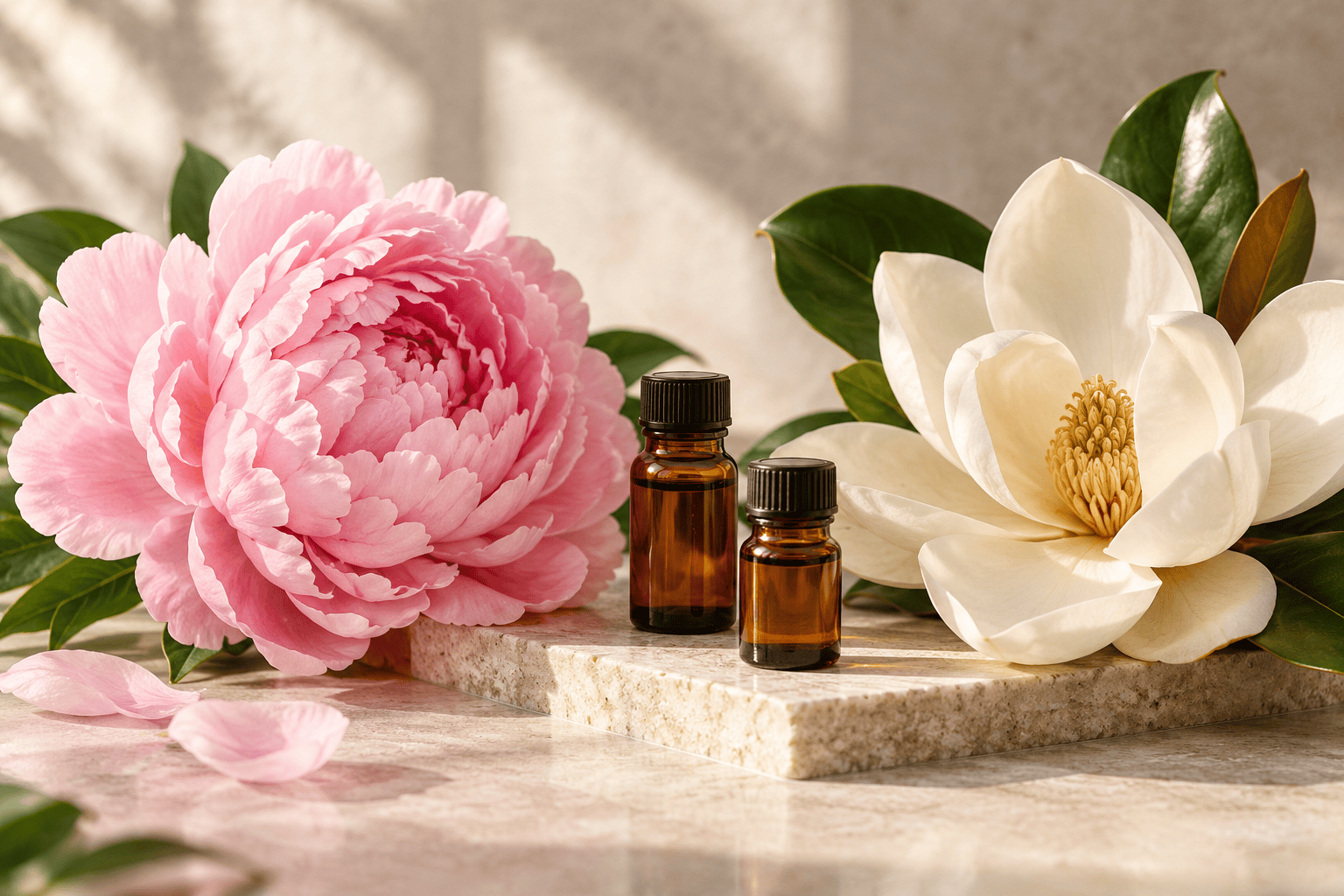
Use flower names as starting points rather than specifications
Two suppliers may interpret peony differently, and magnolia-inspired blends can vary just as much. Write a practical brief that includes desired freshness, petal character, sweetness and body. Givaudan’s ingredient descriptions connect peony with soft floral accents and magnolia with floral density. Givaudan: floral facets in fragrance ingredients Those examples do not create a universal classification or disclose any SHEAIN formulation. They simply show why descriptive facets are more useful than a flower name alone when buyers need to compare a small, purposeful sample set.
Compare transparency without equating it with low intensity
An airy floral can be quite noticeable while still feeling open and light. Ask whether the sample has clear petal definition or a dense, blended floral impression. Rate intensity separately so a quieter candidate does not automatically win the transparency question. For a peony-led concept, useful feedback might preserve petal freshness while reducing a heavy sweet background. Avoid asking for more peony without describing the sensory change you expect; that instruction gives the supplier little guidance about the next revision.
Evaluate roundness without assuming creaminess is required
For a magnolia-led concept, the buyer may want a broader, smoother floral shape, but not necessarily a strongly creamy or cosmetic effect. Compare how the scent develops rather than judging only the first sniff. Record whether the rounded impression remains floral or turns into generic sweetness. A fresh magnolia interpretation is entirely possible as a creative brief. The point is to choose an intentional balance, not to force every sample into a rigid light-peony versus heavy-magnolia stereotype.
Check the supporting green, citrus and fruity accents
The surrounding notes can explain why two flower-named samples seem surprisingly similar. If both share a prominent fresh fruity opening, their differences may emerge only later or in the product base. Ask assessors to identify the main background association and whether it supports the intended floral identity. When your range already contains a fresh floral product, compare the new candidate against that internal benchmark. A different flower name on the package does not guarantee a meaningfully different customer experience.
Use the same product base for a fair comparison
Prepare both directions in the intended formulation at technically reviewed fragrance levels. Hold the base, process and observation conditions constant, and include an unfragranced control where useful. Compare petal clarity, floral body, unwanted sweetness and fit with the product concept. These are suggested evaluation dimensions, not published performance results. Safety, stability and package compatibility remain independent requirements. A fragrance preferred on paper may not be the better choice once the actual product changes the balance of its floral facets.
| Dimension | Peony-led brief might seek | Magnolia-led brief might seek |
|---|---|---|
| Petal character | Airy definition | Broader floral shape |
| Texture | Open and transparent | Rounded but not necessarily heavy |
| Background | Restrained sweet or fruity support | Balanced green or creamy support |
| Approval | Actual sample in the base | Actual sample in the same base |
Choose the role the fragrance should play in the range
If the goal is a light fresh variant, specify the degree of openness and the unwanted heavy notes. If the goal is a softer, rounded variant, define how much body is desirable without becoming overly sweet. Share the preferred sample and one contrasting reference with SHEAIN for a concentrate-selection discussion. Confirm the accepted code and version rather than ordering by flower name alone. Do not claim natural flower extraction or botanical benefits unless the specific product documentation supports those statements.
Frequently Asked Questions
Is peony always lighter than magnolia?
No. These are useful creative starting points, not fixed properties of every fragrance bearing those names.
Can the two directions smell very similar?
Yes. Shared supporting accords can dominate both. Compare blind and examine the middle and later stages as well as the opening.
Does a flower name prove that flower extract is present?
No. Ask for documented ingredient or origin information if it is required for your commercial claims.
Related Guides and Application Support
- Fragrance Sensory Evaluation: How to Build a Reliable Sample-Scoring Process
- Custom Fragrance Development: From Creative Brief to Approved Formula
Contact SHEAIN with your end-use application, target market and scent brief to discuss fragrance oil concentrate samples.


