

White tea vs green tea fragrance oil is a comparison of scent directions, not a reliable way to identify ingredients or performance. For purchasing, start with the impression you want: airy and softly floral, sharply leafy, dry and tea-like, or bright with citrus. Then compare actual samples in the intended product. Two suppliers can interpret the same tea name very differently.
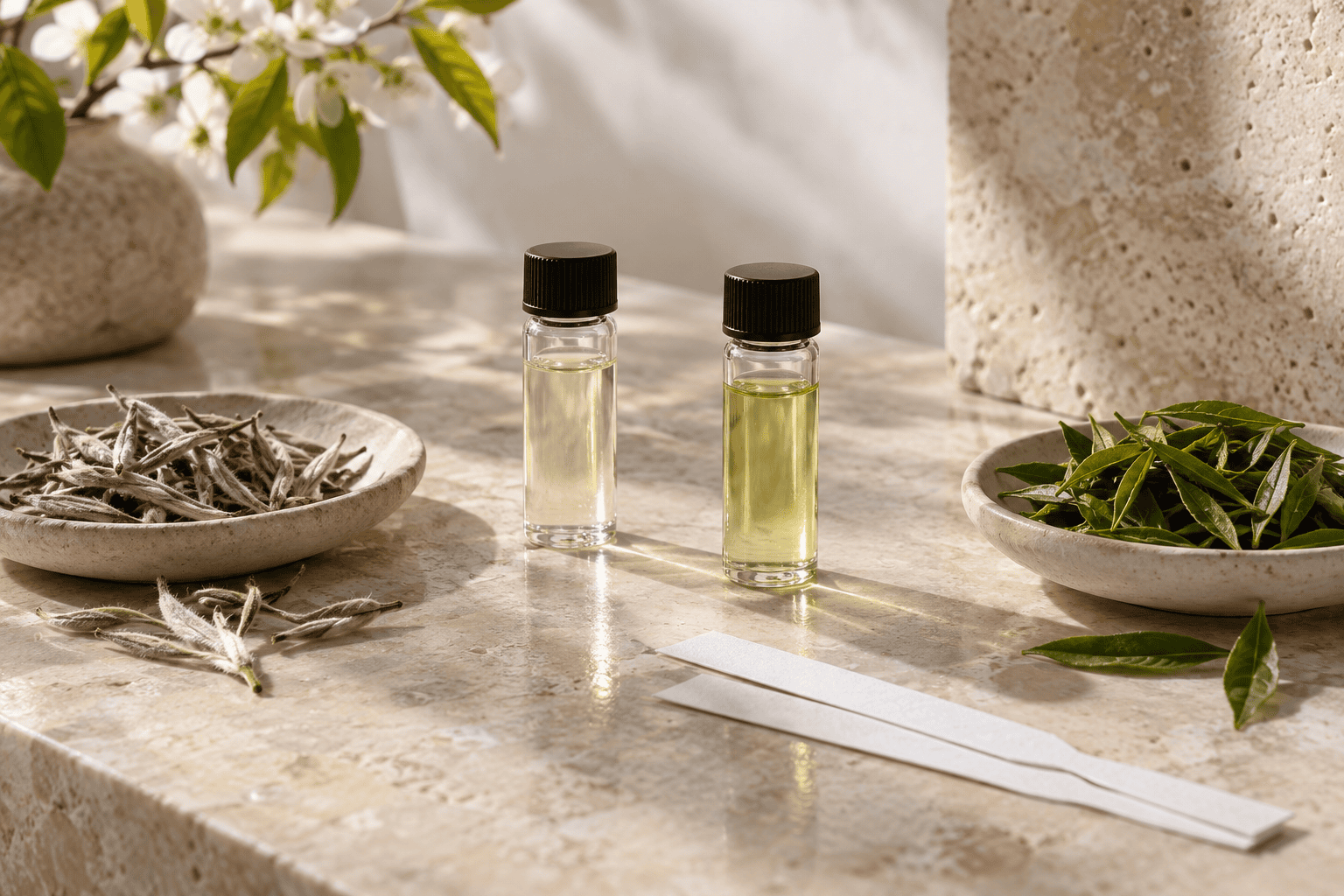
Treat tea names as creative briefs, not specifications
A fragrance oil sold under a tea name is a composed scent, not necessarily an extract from that tea. The name does not establish botanical content, solubility, natural origin or suitability for a particular application. Ask the supplier what the product is before discussing its story. CandleScience’s White Tea note profile, for example, includes citrus, herbal and floral elements; it illustrates one interpretation, not an industry-wide definition. CandleScience: White Tea, an example of a constructed note profile
Use four sensory questions to separate the candidates
Instead of asking which sample smells more expensive, ask whether the opening feels leafy or citrus-led; whether the middle remains recognizably tea-like; whether sweetness interrupts the dry character; and whether the finish feels airy, musky or woody. Use these as your own working vocabulary. A white-tea brief might prioritize soft transparency, while a green-tea brief might prioritize a crisp leaf impression. Neither direction is compulsory, and a supplier may offer a white-tea sample greener than a competitor’s green-tea sample.
| Decision point | Possible white-tea brief | Possible green-tea brief |
|---|---|---|
| Opening | Soft and spacious | Crisp and leafy |
| Middle | Delicate floral-tea impression | More explicit leaf or dry-tea impression |
| Avoid if unwanted | Excessive powder or sweetness | Harsh herbal or cleaner-like edges |
Make the comparison relevant to the finished product
For a candle project, compare the two approved samples in the same wax and vessel and evaluate the finished candles under the same conditions. For a wash-off product, include the actual unscented base and evaluate the diluted use stage as well as the bottle. The question is whether the intended tea identity survives the product experience. A beautiful opening on a strip is not enough if the finished product is perceived only as generic citrus or clean musk.

Separate a scent revision from a performance revision
If both samples smell too sweet, that is a direction problem: request a drier interpretation. If the preferred tea identity is present but becomes weak in the chosen base, describe the stage where it disappears and ask for application support. Do not ask for “more tea” and “more strength” as though they were the same change. Increasing dosage may increase unwanted citrus or musk along with the tea impression, and may introduce technical or use-limit constraints.
Write a brief that gives the perfumer useful boundaries
An illustrative request is: “A green-tea direction for our liquid hand wash, with a recognizable leafy heart, restrained sweetness and no dominant lemon-cleaner association. The attached approved product is a direction reference, not a request to copy its formula.” Add the actual base, target market, expected use stage and commercial constraints. If botanical or origin claims matter, request documentary confirmation separately; a scent name cannot substantiate them.
Approve a specific sample rather than an abstract tea category
Retain the chosen sample code and revision together with a short description of what won approval. Record which attributes must remain recognizable and which are flexible. This prevents the next purchase from becoming an argument about what white tea “should” smell like. SHEAIN supplies fragrance oil concentrates; share the application and your tea brief when requesting options, and confirm current availability rather than assuming every tea interpretation is a stocked formula.
Frequently Asked Questions
Is white tea fragrance oil made from white tea?
Not necessarily. Ask for composition and origin information if the presence of a tea-derived ingredient matters to your claim.
Which tea fragrance lasts longer?
The name alone cannot answer this. Compare the actual formulas in your intended product and at the relevant use stage.
Can I use the same tea scent across a product range?
You can target a shared identity, but each application needs its own suitability and performance assessment.
Related Guides and Application Support
- Fragrance Sensory Evaluation: How to Build a Reliable Sample-Scoring Process
- Custom Fragrance Development: From Creative Brief to Approved Formula
Contact SHEAIN with your end-use application, target market and scent brief to discuss fragrance oil concentrate samples.


